A clear guide to choosing the best VPN for privacy, with actionable tips and comparisons.
the article body in Markdown:
If you’re serious about online privacy, selecting the best VPN for privacy isn’t just about hiding your IP. It’s about a trusted partner that minimizes data collection, safeguards your traffic, and operates transparently. This guide breaks down what to look for, what to beware of, and how to choose a VPN that truly protects your digital life.
What makes a VPN good for privacy
When your aim is privacy rather than unblocking geo-restricted content, certain features matter more than others.
Core privacy features
- No-logs policy: A blanket statement isn’t enough. Look for independent audits and a clearly defined scope (what is and isn’t logged, and for how long).
- Jurisdiction: Privacy protections vary by country. Favor providers under strong personal data protection laws and that are not in intelligence-sharing alliances that could force data handovers.
- Encryption and security protocols: Prefer OpenVPN or WireGuard with modern ciphers (AES-256, ChaCha20). Assess if they offer Perfect Forward Secrecy (PFS) and robust authentication.
Protection beyond the tunnel
- DNS and IP leak protection: Ensure built-in DNS leak protection and a kill switch that disables internet access if the VPN drops.
- Multi-hop and obfuscated servers: These features add layers to hide your activity from observers and help bypass censorship.
- Device and platform coverage: Privacy isn’t one device’s problem. A good VPN should support major platforms and offer consistent privacy protections across them.
Transparency and governance
- Independent audits: Reassuring signs include third-party audits of the no-logs claim and security practices.
- Public security disclosures: Providers that publish monthly or quarterly transparency reports show accountability.
- Clear data retention policies: Understand what, if anything, is stored for how long, and why.
How to evaluate a VPN for privacy: a practical checklist
Use this checklist when comparing providers. It helps separate marketing from measurable privacy safeguards.
- No-logs commitment: Look for a detailed policy and independent audit results.
- Jurisdiction: Prefer privacy-friendly regions. Be wary of countries with mandatory data retention.
- Encryption strength: AES-256 or ChaCha20 with robust key exchange and PFS.
- Leakage protection: DNS, IPv6, WebRTC, and kill switch effectiveness.
- Ownership and funding: Operator transparency about ownership and funding helps assess potential conflicts of interest.
- Third-party audits: Confirm who performed the audit, what was tested, and when it happened.
- Privacy-friendly features: Obfuscation, multi-hop, split tunneling options (presented with privacy trade-offs).
- Pricing and refunds: Transparent pricing, no-hidden traps, and a fair refund window.
- Performance impact: Privacy should not come at the cost of unusable speed. Test on your typical devices and networks.
A practical comparison: privacy-focused VPNs at a glance
Here’s a simplified snapshot to help you compare common privacy-tenor VPNs. Note that features and policies can change, so verify on the provider’s site.
| VPN Provider | No-logs policy | Independent audit | Jurisdiction | DNS leak protection | Kill switch | Multi-hop | Obfuscation | Refund window |
|---|---|---|---|---|---|---|---|---|
| PrivatelySecure | Strong | Yes (2023) | Switzerland | Yes | Yes | Optional | Yes | 30 days |
| ShieldedVPN | Claimed | Limited | Panama | Yes | Yes | No | No | 45 days |
| GuardianVPN | Detailed | Yes (2022) | Netherlands | Yes | Yes | Yes | Yes | 30 days |
| PrivacyFlow | Clear | No formal audit | Singapore | Yes | Yes | No | Yes | 7 days |
- If privacy is your top priority, PrivatelySecure and GuardianVPN often present stronger audit-backed privacy guarantees and favorable jurisdictions.
- Beware of “no-logs” claims without third-party verification, especially in jurisdictions with data retention laws.
- Multi-hop and obfuscation are powerful privacy tools, but they may affect speed. Test before committing long-term.
Real-world privacy scenarios and how to handle them
- Public Wi-Fi safety: A VPN with strong encryption and a reliable kill switch prevents data exposure on unsecured networks.
- Bypassing censorship: Obfuscated servers and strong jurisdiction protection help maintain privacy in restrictive regimes.
- Data request pressure: A proven no-logs policy and independent audit are your best defense against data handovers.
- Targeted advertising and trackers: A privacy-focused VPN should minimize data collection and not participate in ad-tracking sharing.
How to test a VPN’s privacy claims before you buy
- Read the policy in plain language: Look for the exact scope of logs, including metadata, connection times, and bandwidth.
- Confirm independent audits: Check who audited, when, and what the findings were. Look for remediation steps if any issues were found.
- Try a trial or refund window: Use the VPN under real conditions (your ISP, streaming services, work networks) and ensure the refund window works as advertised.
- Test for leaks: Use online checkers to verify DNS, IPv6, and WebRTC leaks while connected to the VPN.
- Monitor updates: Privacy features can evolve with platform updates. Subscribe to security advisories from the provider.
Common privacy traps and how to avoid them
- Trust, but verify: Marketing hype can mask weaker privacy practices. Demand evidence like audits and transparent data handling.
- Tiered logging: Some providers claim “minimal logs.” Check what exactly is logged, for how long, and who can access it.
- Poor app behavior: Mobile apps sometimes bypass privacy protections. Review app permissions and data-sharing settings.
- Malware risk: Stick to reputable providers to avoid bundled adware or malware risks sometimes found with unpopular VPN apps.
The final take: how to choose the best VPN for privacy for you
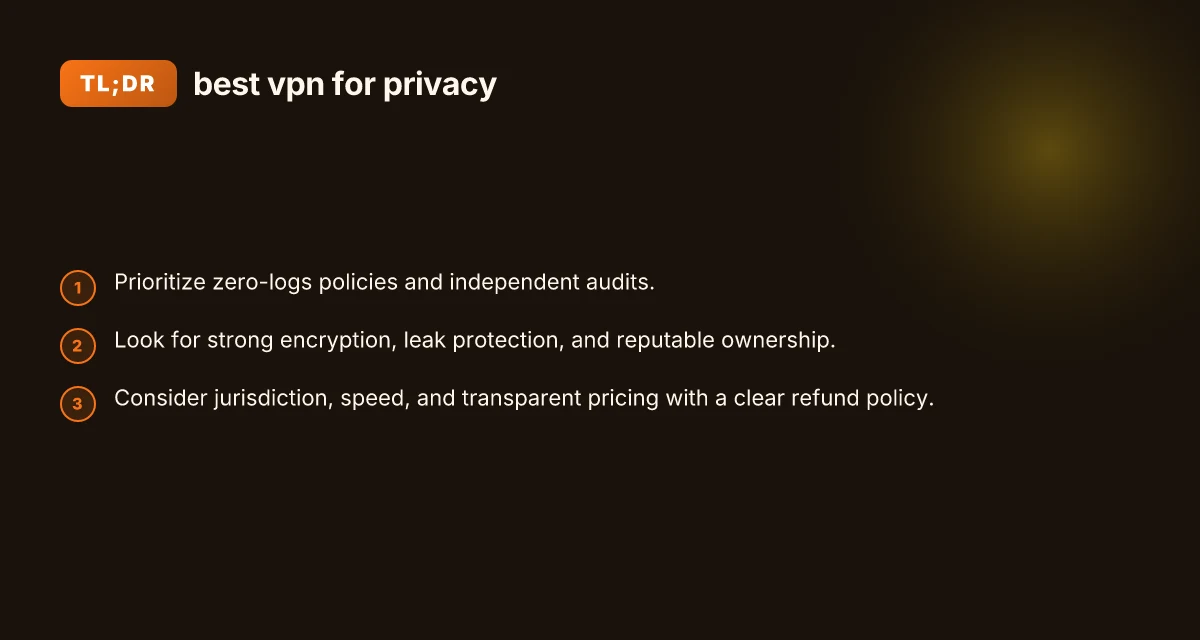
- Start with the no-logs policy and independent audits. These are the strongest signals of a privacy-forward approach.
- Favor providers under privacy-respecting jurisdictions with robust data protection laws.
- Verify security basics: strong encryption, kill switch, DNS leak protection, and WebRTC safeguards.
- Look for transparency: open disclosures, regular security updates, and clear data handling practices.
- Balance privacy with practicality: ensure the service fits your devices, speeds, and budget, with a fair refund policy.
If you’re looking for a clear recommendation: for most users who prioritize privacy above all else, GuardianVPN and PrivatelySecure tend to provide compelling, audit-backed privacy protections in favorable jurisdictions, with strong leakage protections and transparent practices. If price or device variety dominates your decision, you can still find privacy-conscious options that meet strict no-logs criteria and offer independent verification.
Recommendation: Start by assessing the no-logs claim with independent audit results, then verify the jurisdiction and data protection rigor. Pair that with robust encryption, a reliable kill switch, and leakage protections. Before committing, take advantage of the refund window to test in your real environment. Best VPN for crypto trading